Rolling Machines
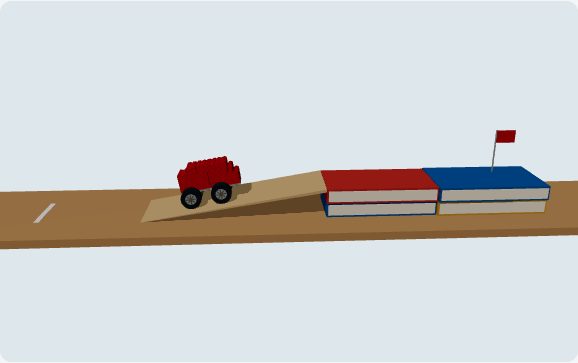
Draw something that rolls, get it back as a brick machine, and test it on courses made of books, a ruler and a box.
 Play it
The question
When a test shows a child why their machine failed, do they rebuild it and try again?
Changing a build after a failure is where the learning happens. If children only pull harder, the toy teaches nothing. If they change the wheels, take a layer off or move the weight, it does.
Why it starts from a sketch
On purpose. The job I made these for asks for napkin sketches turned into play-testable prototypes, so I made the sketch the input: the child's drawing is the napkin sketch, and the game turns it into a machine you can test, change and then build with real bricks.
What you do
You draw a car, or pick one of the sample doodles. An AI reads the drawing (what kind of machine it is and which way it faces) and gives you a first build in real parts: plates, bricks, a pull-back motor and wheels. You choose a course, pull the machine back a few clicks and let it go. When it fails, you change the build brick by brick on a side-view board and go again. When it works, a picture booklet shows how to build it for real.
Choices I made
- What you see is what runs. Every part on the board is a body in the physics, with its own weight. A wheel turns on its own axle, a loose brick falls off. I kept the physics in 2D, from the side, so that every change on the board has a reason you can see in the run.
- The courses are made of things every home has: a board on books, a tunnel under a book bridge, a gap between two rows of books, a box to push off the table, a ruler seesaw, a parking box made of tape, and a final run that joins several of them. Each one can be set up next to the screen, and each has a real setting: how many books, how wide the gap, how heavy the box.
- There are no presets. An earlier version had buttons for wheel size and weight. I took them out, so the only way to change the result is to build.
- The first try fails on purpose. With the default pull, every first build fails the default level of every course, and the tip after the run names something you can build: take the top layer off, put bigger wheels at the front, pull back further.
What I checked
- I ran every course and level against a few hundred builds (four machines, different wheels, pull and weight). Every level can be won, and harder levels are won by fewer builds: on the ramp, 135 builds get up one book and 13 get up four.
- The same runs showed two of my first tips were wrong. Weight on top does not help push the box, and big wheels do not help across the gap. I changed both tips.
- I played the final run by hand. The car got stuck under the bridge (62 mm tall, the bridge was 56). I took the top layer off, then it ran out of push on the board, and five clicks got it through. Three tries.
- The booklet is drawn from the same part list as the game, and a test checks that every part appears exactly once and the counts match the parts list.
What I don't know yet
- The distances are too generous. On a flat table the car goes about 4 m at five clicks. Spring strength and rolling resistance are my estimates, and a real pull-back car will go less far.
- Nobody has built one of these machines with real bricks. The parts are sold today, but this combination hasn't been put together by hand, and I haven't checked how the motor mounts on the base.
- No children have drawn for it. The sample doodles come from a public drawing dataset, mostly drawn by adults.
- It is tested in Chromium and Firefox, not in Safari.
How I'd test it
- Who
- First five adults over a video call, to catch what is confusing. Then six to eight children aged 7 to 10, in pairs, with a parent in the room, twenty minutes each.
- Setup
- A laptop or tablet, and the first course built for real next to it: two books and a board.
- What I watch
- After a failed run, does the child change the build or only pull harder? How many changes before they win? Do they read the tip? Do they want to build it for real at the end?
- What counts as a yes
- At least four of six children make a building change after a failure without being told to.
- What it decides
- If they rebuild, the next step is more parts and more courses. If they only pull harder, the tips and the courses have to make building the obvious fix before anything else is added.
Next steps
- Build the car from the booklet with real bricks and a pull-back motor. Measure how far it goes at each click and how many books it climbs, and set the spring in the simulation from those numbers. About one afternoon.
- Hand the booklet to a child without help and note every step where they stop.
- Run the sessions above.
Where it could go
Children make courses too, out of the same household things, and share them so others can download and race them, with a leaderboard on every course, the way Trackmania players share tracks. The game posts a new course every week, and the challenge is to design the machine that gets through it best.
Later the machines don't have to be cars: robots, walkers, anything with parts. And since every course is made of books and rulers, the same races can be set up on a real table, with real machines, and turn into competitions.
What already exists
I looked after building it. The pieces are all out there:
- LEGO Fusion: Create and Race (2014 to 2015): build a flat brick car on a capture plate, scan it with a tablet and drive it in an app. It was stopped after a year, and reviewers called the scanning hit-or-miss.
- Bad Piggies (2012): the side-view build, test and rebuild loop, with wheels, motors and boxes.
- Brick Quest and BrickGPT (Carnegie Mellon, 2025): a photo or a sentence becomes a buildable brick model with instructions.
- Trackmania: shared tracks, leaderboards and a track of the day, the model for the sharing idea.
What I didn't find is one thing that chains them: a hand sketch, a build in real parts including a pull-back motor, physics part for part, courses made of household things, and a booklet to build it and race it on a real table. The pieces exist. The bridge between them is the idea.
A personal project, not made, endorsed or affiliated with the LEGO Group. LEGO is a trademark of the LEGO Group. Products named above belong to their owners; every link was checked on 6 November 2026.