Three small prototypes about playing with bricks and a screen. I built each one to answer a single question, and they all run in a phone browser. Each has a page of notes: what I checked, what I don't know yet, and how I'd test it with children.
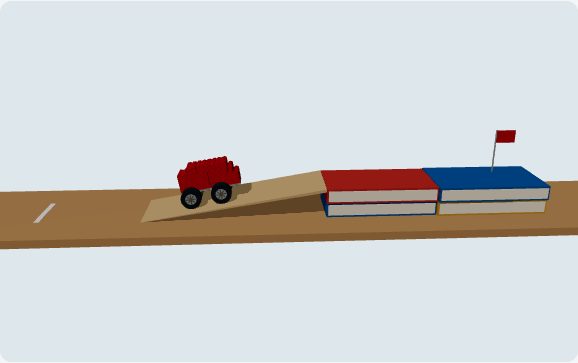
Draw a car, change it brick by brick, and test it on table-top courses made of books, a ruler and a box. The physics runs on exactly the bricks you see.
Question: will children rebuild and try again when the test shows them why it failed?
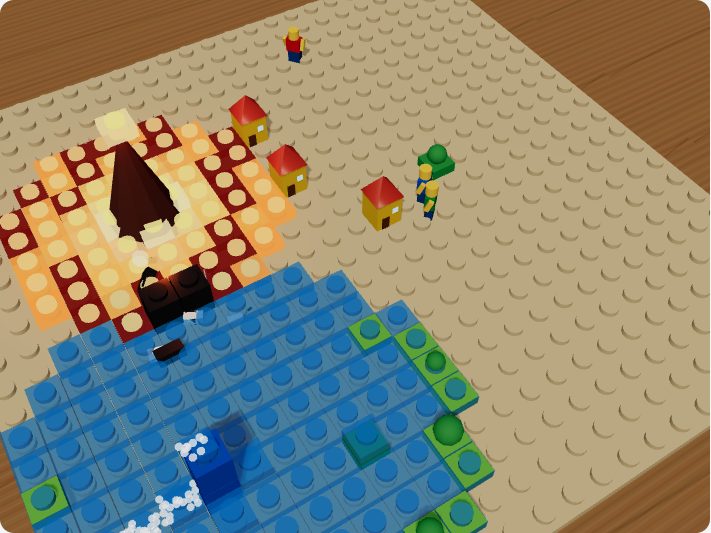
Every brick colour is a rule. Water runs downhill, seeds grow where it is wet, lava burns whatever it reaches. Build a wall in time and the village is safe.
Question: do simple rules make children build whole worlds instead of single objects?
Each one answers a single question today. If the answers are good, this is the direction. The notes pages have the detail.
Rolling Machines becomes a place where children make courses too, race each other's machines on leaderboards, and meet a new course every week. Notes
Living Plate gets a story campaign and weekly missions, and grows into your own brick city brought to life in AR. Notes
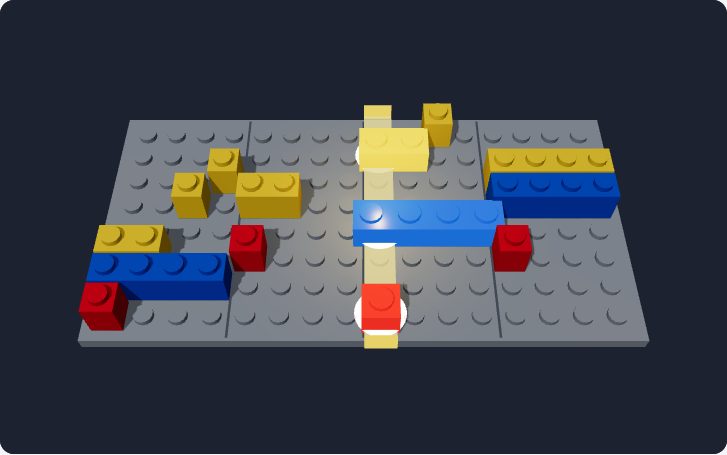
Brick Beats grows into a music-making tool where songs are published and the plate is the song you hold. Notes
How I test and change them
The same loop runs for all three. Steps 1 to 3 are done for each prototype. Steps 4 to 7 come next, and each notes page has the details for that prototype.
1
Ask one question. Write it so a play session can answer it, and decide before building what a yes looks like.
2
Build the cheapest version that can answer it. Rules on a screen before a camera, a side view before full 3D. Anything the question doesn't need stays out.
3
Check it myself. The rules are written as tests, I play it by hand on a laptop and a phone, and I look at screenshots of each moment to catch what reads wrong. Whatever I can't check this way goes on the notes page as unknown.
4
Adults first. Three to five adults, thinking aloud. They find the confusing parts, so the sessions with children test the idea and not the interface.
5
Children, watched and not taught. Short sessions with a parent in the room, one line of instruction, then I only watch. I note what children do (what they change, when they retry, what they build on an empty plate) more than what they say.
6
Change one thing. After each round, one change aimed at the weakest moment, then the same session again. If two rounds bring no progress on the question, the prototype stops there.
7
Check against real bricks. Anything the screen simulates gets measured with real parts: how far a pull-back car really goes, and whether a phone can read a real plate.
Living Plate and Brick Beats are meant for a real baseplate under a phone camera. The camera part isn't built yet, so for now you build on screen, with the same rules.